Almost everyone thinks about death at some point, and many people feel uneasy when they do. For some, that unease grows into a worry that follows them through the day. This guide explains what the fear of death is called, how everyday death anxiety differs from a phobia, why it develops, and what helps.
The short answer: Fear of death is a natural response to the idea of dying or no longer existing. Clinicians often call it death anxiety. The term thanatophobia is used when the fear becomes intense enough to disrupt daily life. Many people manage milder fear with self-help strategies, and therapy can help when it starts to take over.
What is the fear of death called?
The fear of death is commonly called thanatophobia. The word comes from the Greek thanatos, meaning death, and phobos, meaning fear, according to Psych Central.
Two details matter here. First, thanatophobia is not listed as its own disorder in the DSM-5, the manual clinicians use to diagnose mental health conditions. Medical News Today notes that in a clinical context it is usually called death anxiety. Second, Psych Central explains that because there is no separate diagnosis, a clinician may use the criteria for a specific phobia to judge whether the fear has reached phobia level.
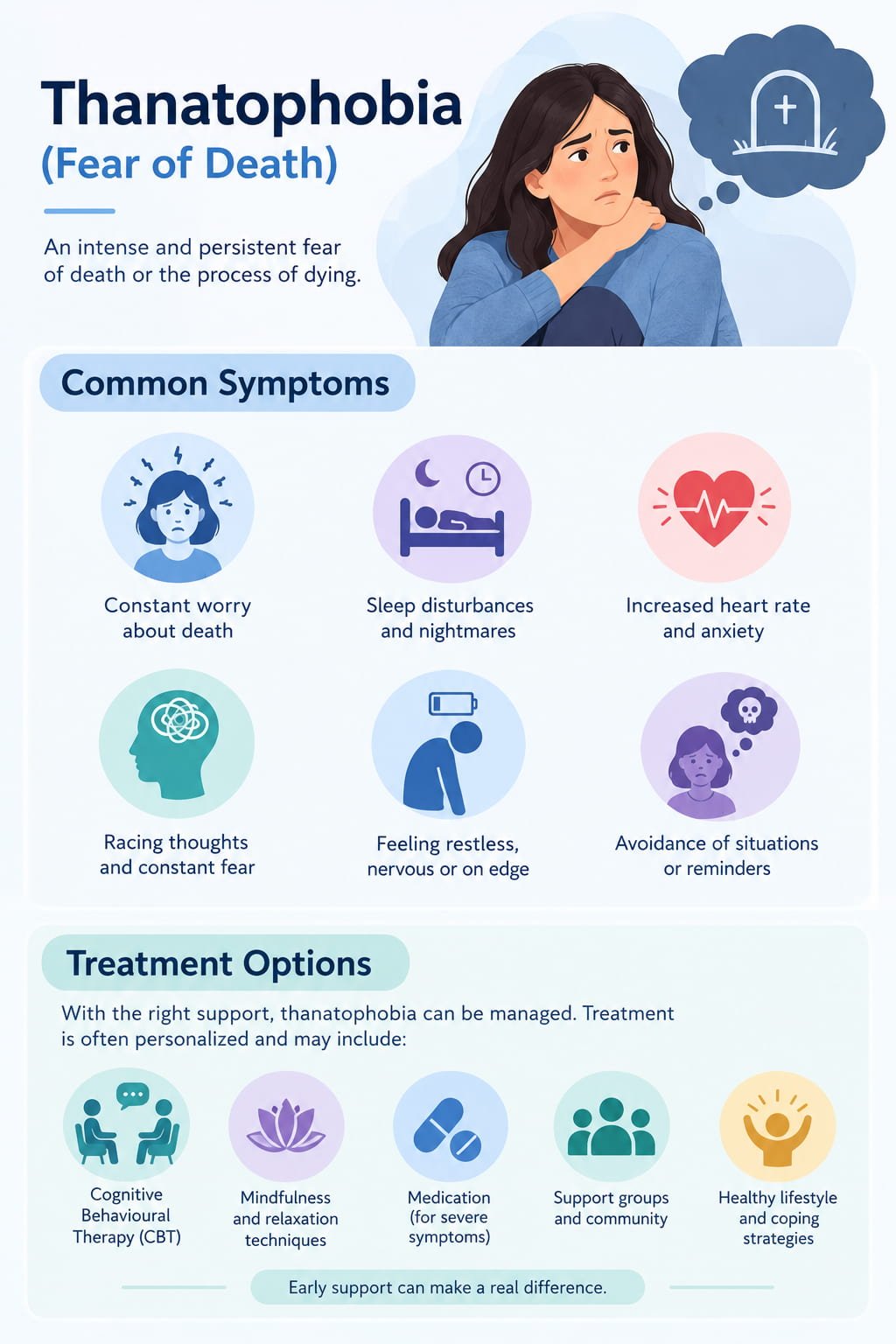
“Fear of death” can also mean different things: fear of the dying process, fear of being dead, or fear of losing people you love. It helps to know which one you mean, because each calls for a different response.
Fear of Death vs. Death Anxiety vs. Thanatophobia
The terms overlap, and professionals do not use them identically. Therapist.com describes death anxiety as a broad concern about mortality that many people feel to varying degrees, and thanatophobia as a more severe fear with intrusive thoughts that affect daily life. That gives a useful working distinction:
| Everyday fear of death | Death anxiety | Thanatophobia | |
|---|---|---|---|
| Typical pattern | Passing unease, often after a loss or bad news | Recurring worry about mortality that comes and goes | Persistent dread or panic at thoughts of death |
| Effect on daily life | Little or none | Noticeable but manageable | Disrupts sleep, work, relationships or choices |
| Usual next step | Self-care and talking it through | Self-help, possibly counselling | Professional assessment |
Treat the table as a guide, not a diagnostic tool. The lines between the columns are blurry, and only a qualified clinician can assess where you fall. For the clinical side, read guide about thanatophobia.

Signs it may be more than ordinary worry
Look at how the fear behaves, not only how strong it feels. Clinical and consumer health sources describe patterns like these:
-
- Sudden dread, anxiety or panic when thinking about dying
- Intrusive thoughts about death that are hard to switch off
- Avoiding anything that brings death to mind, such as funerals, hospitals or conversations about illness
- Physical symptoms, such as nausea or stomach pain, when the topic comes up
- Low mood or general anxiety alongside the fear
If several of these happen most days, consider talking to a professional. Fear of death can also overlap with health anxiety, post-traumatic stress and depression, and a clinician can help sort out which is which.
Why fear of death happens
No single cause explains it. A few ideas come up repeatedly:
-
- Survival instinct vs. reality. Therapist.com describes death anxiety as arising from the conflict between our drive to stay alive and the certainty that we won’t.
- A root fear. Psychologist Ernest Becker argued in 1973 that death anxiety underlies many other fears and phobias, according to Simply Psychology. That is a theory, not settled fact.
- Triggers. A loss, a health scare or a traumatic event can bring the fear to the surface. Psych Central names trauma as one contributing factor.
- Age. It is not only an older-age problem. Medical News Today reports that young people are as likely as older adults to experience it, and cites a study in which death anxiety surfaced in individuals in their 20s, with a second rise for women in their 50s.
How to cope with fear of death
These are general self-help ideas based on common anxiety-management principles. They are not a treatment plan.
-
- Name the specific fear. “I’m afraid of death” is too big to work with. Write down what exactly bothers you: pain, leaving family, the unknown, losing control. Medical News Today says facing death anxiety starts with understanding what you fear about death.
- Turn dread into one practical step. If you worry about leaving family unprepared, a will, a beneficiary check or a conversation with relatives gives the worry somewhere to go. If the fear is about your health, book the checkup instead of searching symptoms at 2 a.m.
- Use grounding when it spikes. Slow breathing and sensory exercises such as 5-4-3-2-1 shift attention to the present. They calm a surge. They do not remove the underlying fear.
- Cut the fuel. Doomscrolling, symptom searches and late-night rumination tend to feed the loop. Set limits where you notice a pattern.
- Talk about it. Death is a taboo topic for many people, so the fear stays private. A trusted friend, spiritual leader, support group or counsellor can make it less isolating.
- Face it in small steps. Avoidance keeps fear alive. Exposure-based work builds a “fear ladder” of situations, from least to most upsetting, as a Psychology Tools handout describes. If your fear is intense, do this with a therapist rather than alone.
- Spend time on what gives life meaning. Relationships, values and projects that matter to you will not erase the fear, but meaning-focused approaches appear in the research on death anxiety, covered next.
What treatment looks like, and what the research shows
Therapies used for death anxiety include Cognitive Behavioural Therapy (CBT), which often involves exposure, acceptance and commitment therapy, and meaning-focused approaches. The honest picture is that the research is thin:
-
- A 2022 review describes a meta-analysis in which CBT significantly reduced fear of death compared with other therapies. It also points out that only five CBT studies were identified, most used graded exposure, and just one was recent.
- A 2019 umbrella review of 24 studies, available through the University of Adelaide library, rated the evidence for psychological interventions as low quality.
- A 2024 network meta-analysis of randomized trials in Frontiers in Psychology ranked rational-emotive hospice care therapy highest. The participants were patients, so the result may not transfer to the general public.
Key takeaway: CBT-based approaches have the most support so far, but no approach is guaranteed, and much of the research involves people with serious illness. Questions about medication belong with a doctor.
When to get help
Consider speaking with a family doctor, psychologist or another registered mental health professional if:
-
- The fear persists and shows up most days
- You have panic attacks or cannot stop the thoughts
- You avoid medical care, places or people because of it
- Sleep, work or relationships are suffering
- You also feel hopeless or depressed
If thoughts about death turn into thoughts of harming yourself, call or text 988, anytime, in Canada or the United States (988.ca for Canadian details). If you are in immediate danger, call 911.
The bottom line
Fear of death is part of being human, and it responds to attention and support. If yours has started to run your days, you do not have to manage it alone.
Frequently Asked Questions
Is fear of death normal?
Some fear is common. Psych Central says death anxiety is not uncommon. It becomes a concern when it persists and disrupts your daily life.
Is fear of death a mental illness?
Not as a standalone diagnosis. It is not its own entry in the DSM-5, but a clinician may assess it as a specific phobia, and it can be linked to conditions such as anxiety or depression.
Can fear of death go away?
Many people find it eases with coping strategies or therapy, but research is limited and nothing is guaranteed. The realistic goal is usually a fear you can manage, not one that disappears.
What helps in the moment?
Slow your breathing, try a grounding exercise, and name the thought for what it is: “I’m having a fear-of-death thought.” Moving your body or calling someone can also break the loop.
This article is general information. It is not a diagnosis or a substitute for care from a qualified professional.

Umair Ausaf is a compassionate psychotherapist with 12+ years of experience helping individuals and couples navigate anxiety, trauma, relationships, addiction, and major life challenges toward lasting change.